
 English
  Chinese
 IML Robot

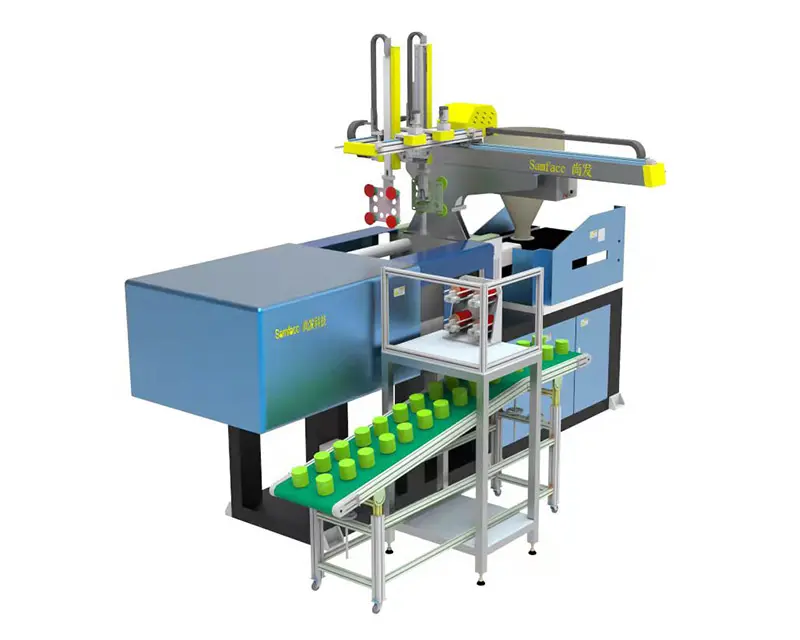
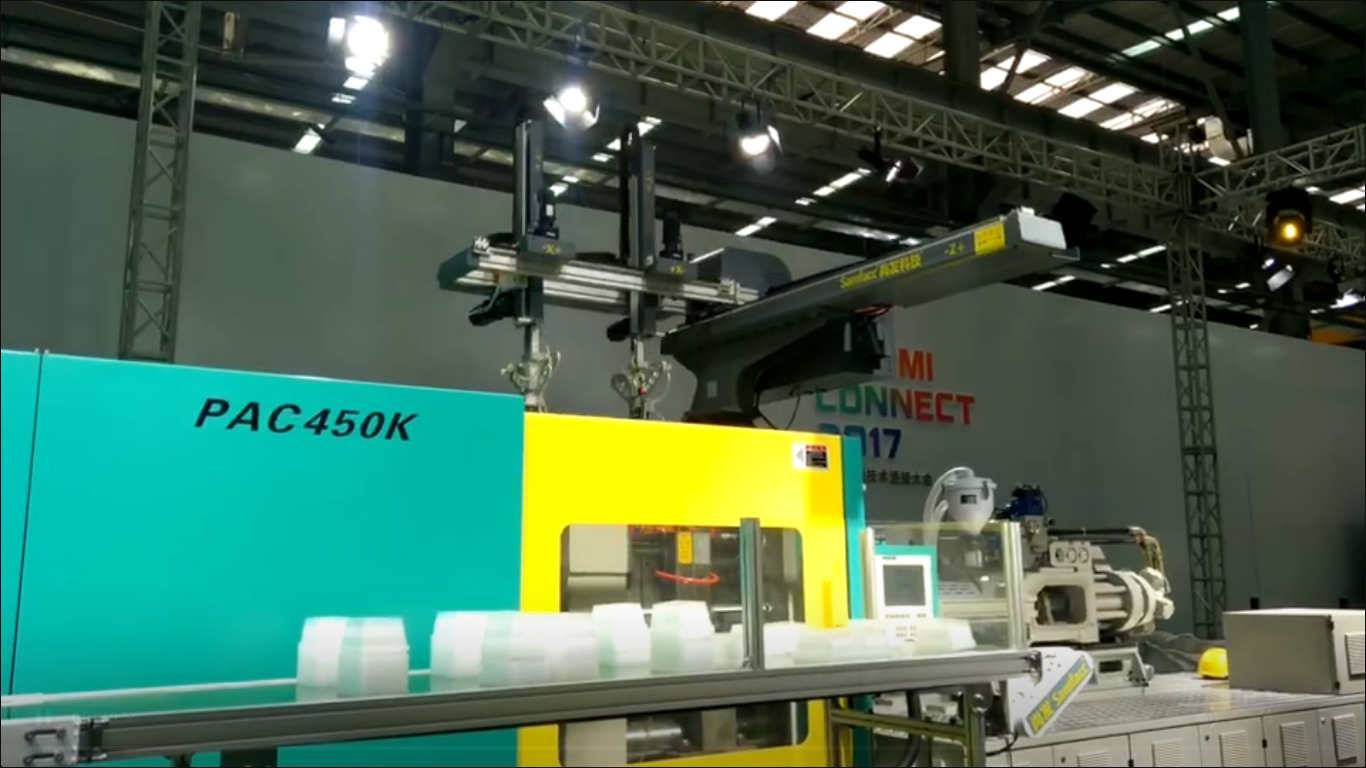
Samfacc’s High-efficiency IML Robot
Foshan Samfacc Robot Co. Ltd is a renowned manufacturer and wholesaler of IML robots and automation robots that are efficient and of high precision quality. Our IML Robots come with top entry IML and side entry IML robots which makes both plane and surface product packaging very efficient.
Samfacc In Mould Labeling Robot Application Scenarios
The In-mold labeling, IML, robot combines the label and automation robot functions, it is customizable and widely used for the product regeneration process in the food packaging industry. This is because it is efficient in the conservation of the environment. The IML robot is composed of the top and side entry IML robots and can be used to label plane and surface products.
Food, Beverage & Dairy Packaging
Typical applications: ice cream tubs, yogurt cups, butter boxes, takeaway containers, beverage lids.
- With IML in mould labeling, printed labels are inserted and fused directly into the container wall during the molding cycle.
- The outcome is a smooth, scratch-free surface with high cold and moisture resistance — perfect for frozen and chilled foods.
- In comparison to conventional post-labeling, the in mold labeling process obviates the requirement for additional labeling operations, saves labor, and enhances overall sanitation and production throughput.
Personal Care, Cosmetics & Health Products
Typical applications: shampoo bottles, cream jars, cosmetic caps, body-lotion jars.
- In mould labeling offers high definition images, sharp textures, and high-end finishes like matte, gloss, or metallic looks.
- The IML in mould labeling process, which combines the decorative coating and bottle surface, leads to improved scratch resistance and a premium, long-lasting appearance.
- It does away with secondary coating or adhesive labeling and addresses both looks and environmental concerns.
Household & Cleaning Product Containers
Typical applications: spray trigger cans, disinfect jars, storage boxes, cleaner cans, detergent bottles.
- The in mold labeling process allows long-term stability even in situations subject to sunlight, chemicals, or moisture.
- Positioning of the label does not change at all due to robotic precision and high-speed processing for mass production.
- Since labels and containers are produced with the same resin base, in mould labeling labeling ensures total recyclability and eco-friendly manufacture.
Industrial, Automotive & Electronics Components
Typical applications: automotive instrument panel fronts, appliance front panels, electronic boxes, and home control user interface panels.
- With IML in mould labeling, in this instance, often paired with IMD (In-Mould Decorating) to bring structural and decorative layers together.
- Labels can provide high temperature resistance, abrasion resistance, and chemical durability for long-term performance.
- In mould labeling also enables transparent display windows, illuminated symbols, and functional touch interfaces.

IML Robots Features & Technical Advantages
The robotic arm is equipped with advanced servo motors and position sensors to achieve precise label insertion inside the mold cavity. During IML in mould labeling, label deviation is kept under ±0.02 mm, ensuring perfect alignment even in multi-cavity molds. This guarantees consistent product appearance and reduces waste caused by label misplacement.
Designed for synchronization with high-speed injection molding machines, the robot completes label loading within seconds. The in mould labeling cycle matches 2–3 second molding times without compromising stability. Full-servo control minimizes energy use, while eliminating secondary labeling equipment makes the in mold labeling process cleaner and more efficient.
Our robots feature a modular structure — suction cups, electrostatic pads, and grippers can be changed within minutes to adapt to different products or molds. This flexibility enables rapid format switching for various packaging types, fully supporting IML in mould labeling across food, cosmetic, and industrial applications.
The control system integrates motion coordination, error detection, and real-time monitoring throughout the in mould labeling workflow. With built-in safety interlocks and predictive maintenance alerts, the robot ensures long-term reliability in continuous in mold labeling process environments. This robot is very safe and highly hygienic, and can be comfortably used to handle food packaging and processing.
How the IML Robot Works
During the in mould labeling process, the IML robot automatically picks up the pre-printed labels and places them precisely within the open mold cavity. When the mold is closed, hot plastic is pumped in, attaching the label to the molded part permanently. The flush mounting makes the label part of an integral surface coat instead of an external decoration. The entire IML in mould labeling process — from the feeding of the label, through its positioning, molding, all the way to finished product ejection — is automated, which provides high speed, precise positioning, and consistent product quality. As a result, in mould labeling gives a durable, high-quality finish with minimal manual handling and time consumed during production.

FAQ
Q1: What makes the in mould labeling process different from traditional labeling methods?
A1: At Samfacc, we use the in mould labeling process to integrate labels directly during injection molding, rather than applying them afterward. With our IML in mould labeling technology, the label becomes a permanent part of the product surface, saving production time, improving adhesion, and delivering a clean, high-quality finish that stands out from traditional post-mold labeling.
Q2: What are the main benefits of using Samfacc IML robots for in mould labeling?
A2: Our IML in mould labeling robots ensure precise label positioning, fast cycle times, and consistent product quality. With our solutions, you eliminate human error, less waste, and a steady production efficiency — making large-volume in mould labeling cost-effective and viable.
Q3: What materials are suitable for in mould labeling?
A3: In Samfacc, we apply commonly PP, PS, or PET labels that are compatible with the molded substrate. With the application of such materials in our in mould labeling, the label fully blends with the product to create a strong, recyclable surface with good print quality and durability that can last for a long time.
Q4: Which industries benefit most from Samfacc’s IML in mould labeling solutions?
A4: Our in mould labeling products find extensive application in food and beverage packaging, cosmetics, home and personal care products, and automotive parts. Samfacc’s IML in mould labeling solutions offer robust, water-resistant, and aesthetically pleasing surfaces, allowing brands to ensure product integrity while optimizing visual attractiveness across various markets.